JWST finds black hole star candidate
Astronomers using the James Webb Space Telescope have identified an object from 660 million years after the Big Bang as the best candidate yet for a 'black hole star.'
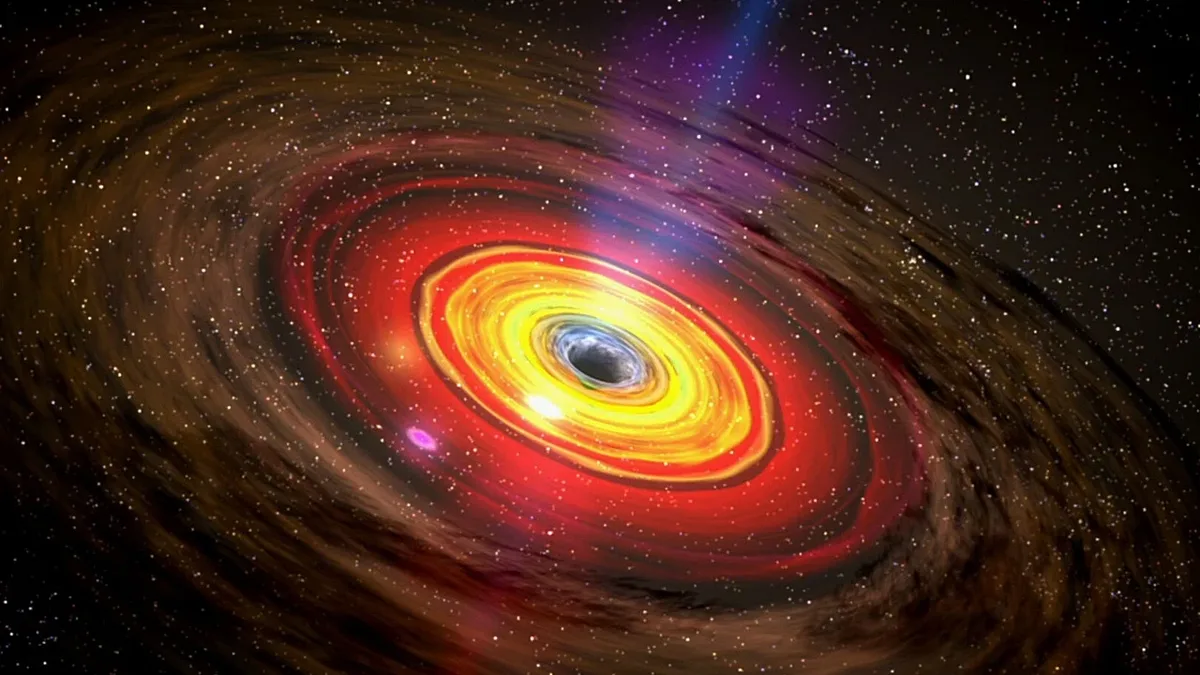
The James Webb Space Telescope (JWST) has identified the most promising candidate yet for a hypothetical 'black hole star,' an object shining 100 billion times brighter than a typical star. The candidate, named MoM-BH-1, was observed as it appeared roughly 660 million years after the Big Bang, according to a study published August 12 in Nature*.
This discovery could help unravel the origin of hundreds of mysterious 'little red dots' (LRDs) spotted by JWST. These crimson objects, nearly as old as the universe, are too bright to be ordinary stars but too dim to be full galaxies, posing a major puzzle for astronomers.
A Singular Red Dot
The candidate object was found by JWST's Miracle or Mirage (MoM) survey. Its intense red color initially suggested it was shrouded in dust, which blocks blue light. However, analysis revealed a missing segment in its light spectrum, known as a Balmer break. This indicates light is being blocked by an extremely dense shell of gas, not dust, similar to the atmosphere around some massive stars.
Study first author Rohan Naidu, an astronomer at the University of Hawaii, stated in an MIT release that the object is 'truly singular in so many ways.' The observed Balmer break is the deepest ever recorded, ruling out ordinary stars as the light source. Furthermore, the gas appears to be composed almost purely of hydrogen and helium, lacking heavy metals.
The Black Hole Star Hypothesis
Simulations run by the researchers suggest the only plausible explanation for the dense, superheated gas is a massive, spinning black hole at its core. In this model, the black hole pulls in matter so rapidly that it also emits enormous energy, superheating a surrounding cocoon of gas. This process replaces the nuclear fusion that powers a typical star.
The team estimates the black hole within MoM-BH*-1 could weigh up to 100,000 solar masses, large enough to be classified as supermassive. This object is older and more distant than a previous candidate known as 'the Cliff,' making it a more critical piece of evidence for the black hole star theory.
Explaining the Little Red Dots
The central mystery of LRDs is their ambiguous nature: too massive for stars, too dim for galaxies. Quasars, luminous objects powered by black holes, have been considered but did not fully match observations because LRDs emit no detectable high-energy X-rays or gamma rays. The dense gas cocoon of a black hole star could theoretically block that high-energy radiation, masking the object's true identity.
The researchers suspect many LRDs could be mini-galaxies with a black hole star at their core. Images suggest MoM-BH*-1 might collide with a primordial stellar cluster in about 100 million years, supporting the idea that such configurations could form. Naidu noted the candidate is so bright it may be 'outshining its surrounding host galaxy,' so we see only the black hole star's light. However, more research is needed to confirm if all LRDs are linked to these hypothetical objects.