Roman-era tomb in Dakhla Oasis reveals unique Amduat scene
A Roman-era tomb at Bir Al-Shaghala necropolis features a rare Amduat scene and a Greek funerary inscription, highlighting religious continuity in Egypt's
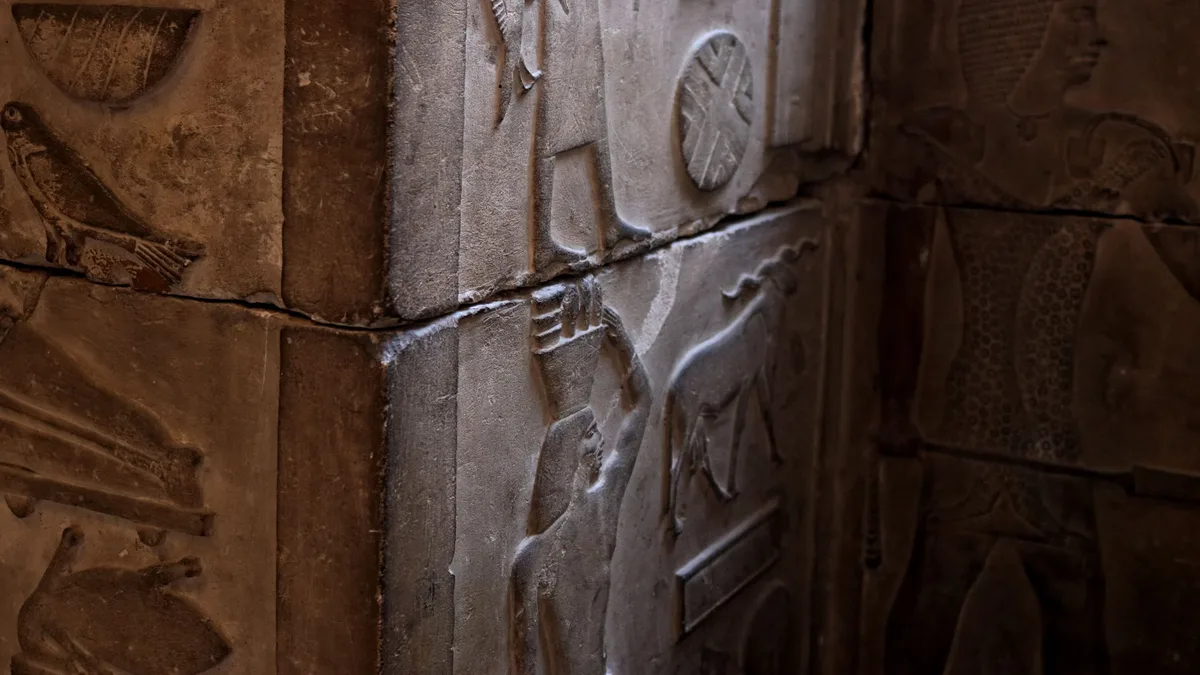
A Roman-era tomb has been discovered at the Bir Al-Shaghala necropolis in Egypt's Dakhla Oasis. The find includes a rare depiction of the ancient Egyptian Amduat text alongside a Greek funerary stele, offering a vivid snapshot of cultural blending under Roman rule.
Fourteen steps lead down to the tomb's entrance. A sandstone doorway, built in classic dynastic Egyptian style, is carved with hieroglyphic funerary spells and iconography. It was sealed with a heavy stone block engraved with an image of the god Osiris and more protective texts. The tomb itself is a small mudbrick structure, built in a pyramidal shape and intended for a husband and wife. Inside, a vaulted mudbrick hall leads to two burial chambers on the right side. The roof had partially collapsed.
Unique religious elements
The lintel stone above the doorway carries an extraordinary scene. It depicts the seventh hour of the 'Amduat,' an important New Kingdom funerary text describing the sun god Ra’s nocturnal journey through the underworld. Previously used almost exclusively for pharaohs and select high officials until the 21st Dynasty, this is the first representation of this specific Amduat episode found in the necropolis of Mut. The cornice is also carved with a winged sun disk flanked by two cobras and bracketed by bundles of papyrus reeds.
Embedded in the south wall of the tomb's pyramidal section is a funerary stele with a triangular top and a raised sun disk. It bears a 19-line funerary poem written in Greek with red paint. Researchers date this inscription to the late third or early fourth century A.D. Preliminary study suggests the poem is dedicated to a man named Psychis, who may have held a judicial position. The full wording of the inscription has not yet been published.
Archaeological context
Bir al-Shaghala formed part of the necropolis of Mothis, the ancient capital of the Dakhla Oasis during the Ptolemaic and Roman periods. Egypt's Supreme Council of Antiquities has been excavating there since 2002, uncovering numerous Roman-era tombs with pyramid-shaped superstructures. The broader cemetery shows a pattern where Egyptian funerary beliefs remained central while Greek language and Roman-period architecture appeared alongside them.
The recent excavation also produced material finds from around the site. These items provide context for the tomb's use and the period.
Evidence from the upper section of the monument suggests later reuse. A mudbrick chapel was found above the main entrance, facing a funerary shrine with four square mudbrick pillars. The Constantine coin fits the site’s broad late Roman setting, though officials have not directly linked it to the tomb's original construction. Hisham El-Leithy, Secretary-General of the Supreme Council of Antiquities, stated the tomb's features would provide important information about religious beliefs, burial practices, and cultural life in Dakhla during the Roman period.
The full Greek inscription text and its scholarly analysis are still awaited.