Neutrinos and Muons: The Cosmic Particles
Physicists say trillions of neutrinos and many muons pass harmlessly through the human body each second, originating from the sun and cosmic events.

Approximately 100 trillion neutrinos pass through every human body each second. Tens to hundreds of muons, a secondary particle from cosmic rays, also penetrate us every second.
These estimates come from physicists Michael Pravica of the University of Nevada, Las Vegas, and Lu Lu of the University of Wisconsin-Madison, who spoke with Live Science. The particles are a constant, unfelt reminder of our connection to cosmic processes.
The Ghostly Neutrino Flood
Neutrinos are the most abundant cosmic particle streaming through matter. They originate from nuclear activity. Nearly all neutrinos zipping through us come from the nuclear fusion reactions powering our sun. Some originate much farther away, even from other galaxies.
Neutrinos barely interact with regular matter. They are not electrically charged and possess almost no mass. These qualities make them incredibly difficult to detect, earning them the nickname "ghost particles." Michael Pravica noted that the fact most never interact demonstrates an underlying reality to our existence of which we are largely unaware.
Cosmic Rays and Their Descendants
Other extraterrestrial particles continually strike Earth. Cosmic rays are electrically charged, highly energetic particles traveling at nearly the speed of light from all directions, according to the University of Chicago. While the sun produces very-low-energy cosmic rays, the vast majority come from beyond the solar system. Their origins may include supernova explosions, matter falling into supermassive black holes, or colliding galaxies.
Cosmic rays are mostly protons or the atomic nuclei of heavier elements like helium or iron. When they hit Earth, they are generally blocked by air molecules high in the atmosphere. These collisions generate showers of secondary particles that reach the ground.
Muons are a key component of these showers. They are negatively charged subatomic particles, similar to electrons but over 200 times more massive. At sea level, about one muon passes through per 0.15 square inch per minute. For a person, the number ranges from tens to hundreds per second. Roughly one or two pass through a hand each second. Because muons are electrically charged, they can interact with matter. Their paths can be made visible in a cloud chamber.
Detection and Biological Impact
Scientists estimate the neutrino flux by recording the tiny fraction that collide with matter inside a detector. The IceCube Neutrino Observatory in Antarctica, for instance, uses thousands of light sensors embedded in a cubic kilometer of ice. When a neutrino interacts with an atomic nucleus in the ice, it produces charged particles that emit a faint flash of Cherenkov light. Researchers reconstruct the neutrino's energy and direction from that light.
Estimating the total number involves accounting for detector size, operation time, efficiency, and interaction probability. Lu Lu compares it to estimating fish in a river from the few caught in a coarse net.
Despite the trillions passing through us every second, neutrino interactions with our atoms are exceedingly rare. You might expect no more than roughly one interaction in your body over an entire lifetime. These rare interactions deposit very little energy and pose no health risk at all.
The showers from cosmic rays, however, can potentially affect human biology. At ground level, muons dominate the penetrating charged particles. At higher altitudes, particularly during air travel, other secondary particles like neutrons contribute a significant share of the biologically relevant radiation dose.
Any effects are generally small. For an average person, cosmic radiation contributes roughly 0.4 millisieverts per year. This is about the same as a few chest X-rays spread across the year. It is part of a total natural background of about 2.4 millisieverts from all sources. The dose varies with altitude, latitude, and shielding. At typical ground level, these particles are not considered a significant health hazard. Life on Earth has been bathed in them from the beginning.
A Window to the Violent Cosmos
These cosmic particles are more than a passive background. They serve as tools for discovery. Scientists have used muon detectors to identify hidden passageways in pyramids. High-energy neutrinos allow researchers to study some of the most violent and otherwise hidden environments in the universe.
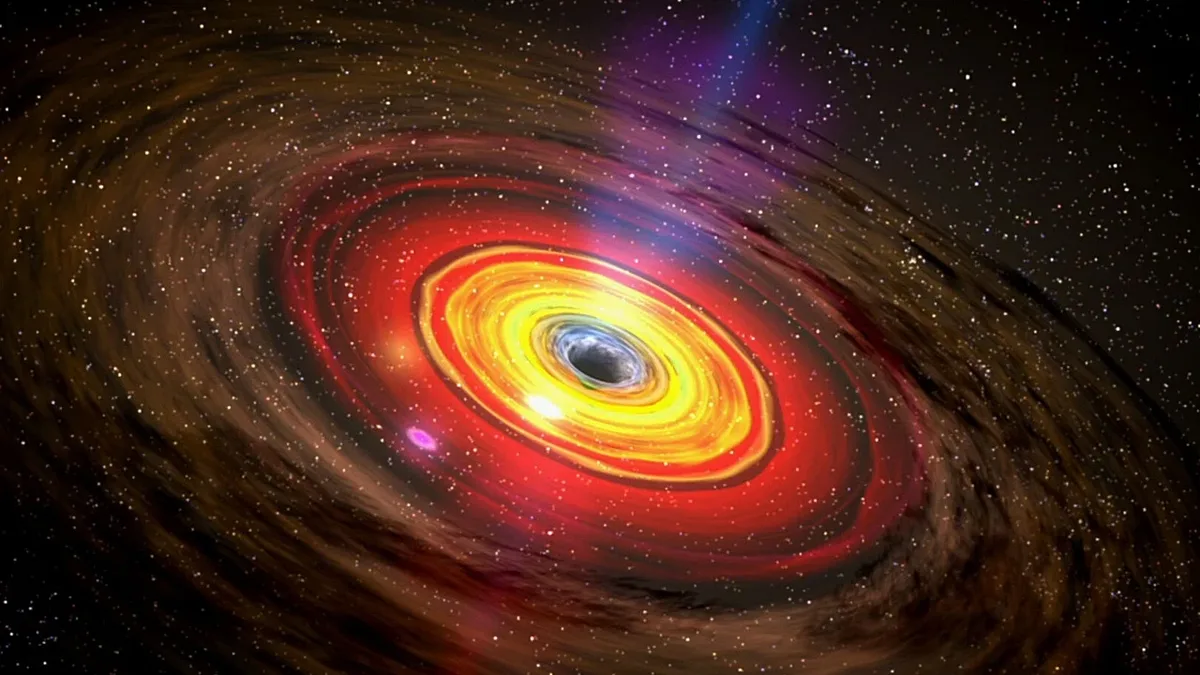
Such environments include the regions surrounding black holes, exploding stars, and other powerful cosmic accelerators. Because neutrinos interact so weakly, they can escape from dense regions that light cannot penetrate. They carry information directly from the sites where nature's most energetic particles are produced.
Lu Lu concludes that the particles streaming through us are a constant reminder that we are not separate from the universe. We are part of a cosmic story stretching back 13.8 billion years.