Roman Aqueducts Built with Precise Surveying and Durable
Roman engineers built long-lasting aqueducts using precise surveying tools and a durable concrete formula, with some structures still functioning today.
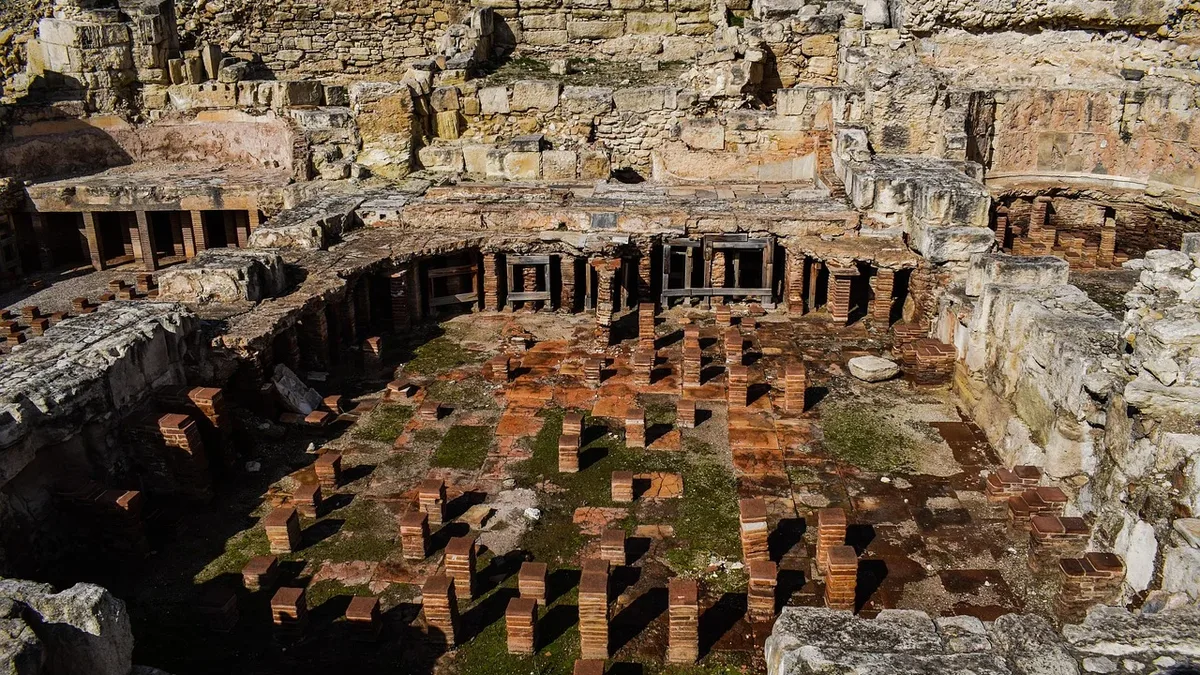
Roman aqueducts, some spanning hundreds of miles, delivered water to cities using a carefully calculated downward slope from a spring source. The Aqua Virgo, constructed in 19 B.C., still supplies water to Rome.
Preparing the Route
Selecting a water source, often a spring, was the first step. The entire channel required a consistent, slight downhill gradient to ensure flow. "To choose a route with the necessary gradient, Roman surveyors would have either used the libra or the dioptra," explained Joseph Lewis, an archaeologist at the University of Cambridge, in a statement to Live Science. The dioptra was a disc with a sighting bar used to measure elevation differences against ground rods. The libra, whose exact design is unclear, employed a suspended plumb bob compared against calibrated staves to determine height variations across the proposed path.
Building for Longevity
Roman concrete was a key ingredient for durability. It incorporated pozzolan, an ashy material, mixed with lime and water, creating a substance that hardened upon contact with water. "Roman concrete certainly played an important role, especially in bridges, arcades, and other structural elements," said Giovanni De Feo, a professor at the University of Salerno. He attributed the structures' remarkable preservation to multiple factors, including route selection along stable geology and ongoing maintenance that often continued for centuries after construction.
Aqueducts did not run entirely above ground. Their design adapted to the landscape. Some had extensive underground sections, while others, like the 250-mile-long aqueduct of Valens to Constantinople, ran for considerable distances on arches. As water approached a city, it often entered settling basins where sediment would sink before the cleaner water continued to a distribution tank.
The workforce needed for construction varied by project. Researchers estimated in a 2022 paper that the roughly 12.4-mile Hadrianic aqueduct at Athens could have been built by a team of 500 workers over 15 years.
Maintenance and Legacy
Regular upkeep was essential. Cees Passchier, head of tectonophysics at Johannes Gutenberg University Mainz, studied carbonate buildup in the Divona aqueduct in France. Maintenance crews would sometimes scrape away these deposits before replastering the channel. For a small site like Divona, a dozen workers might have sufficed, but Rome required a staff of several hundred to maintain its complex water network.
Many aqueducts remained in use long after the empire's fall, maintained through the Middle Ages and into modern times. Their survival is a sign of the precision of Roman engineering and the effectiveness of their maintenance regimes.