Satellite radar reveals 2,600-year-old Saite religious complex in Nile Delta
A 2,600-year-old religious complex from Egypt's Saite period has been identified at Buto using satellite radar and resistivity surveys, revealing a massive structure stabilized by an engineered sand foundation.

A 2,600-year-old religious complex has been identified at the ancient Egyptian city of Buto using satellite radar and electrical resistivity surveys. The structure, dating to the 26th dynasty or Saite period from 688 to 525 B.C., was found beneath a mound known as Kom C in the northwestern Nile Delta.
The site was sacred to Wadjet, the cobra goddess of Lower Egypt. Researchers employed Sentinel-1 radar satellite data and conducted 15 parallel lines of electrical resistivity tomography across an area of 58,100 square feet. This non-invasive approach pinpointed the buried building.
Methodology and discovery process
The investigation began with satellite radar analysis of the Nile Delta. Anomalous areas near the river were flagged for further study. Teams then deployed electrical resistivity tests across the site, creating a 3D model of the subsurface. The surveys revealed the structure's outline between 10 and 20 feet underground.
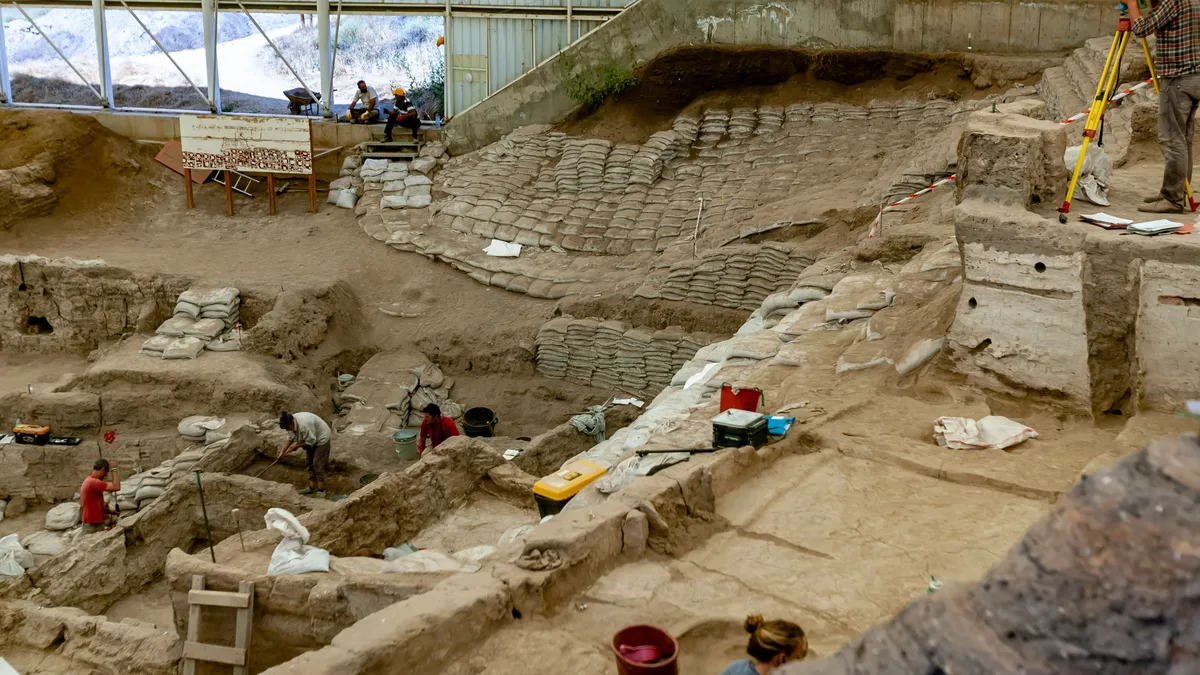
A 3-by-3-foot excavation trench was dug to a depth of 20 to 23 feet to confirm the geophysical data. It exposed mudbrick walls resting on a thick layer of clean sand. This engineered sand foundation, found at a depth of 6 to 7 meters, was deliberately packed beneath the mudbrick to stabilize the large building in the region's waterlogged clay soil. The top three meters of the trench contained broken pottery and debris from later Roman and Ptolemaic occupations.
Archaeological significance
The discovered complex is substantial, measuring 420 feet long and 203 feet wide-roughly the size of a football field. It dates to a key era known as the Saite Renaissance, a time of cultural revival. The structure likely functioned as a specialized facility for religious services or funerary rites.
Excavations within a 100-square-meter area yielded significant ritual artifacts. These included ushabti and shawabti figurines, a limestone altar with residues of dried animal blood, and a faience baboon figurine associated with Thoth, the god of wisdom and writing. A stone offering basin was also recovered. The presence of these items strongly indicates the structure was a temple or large shrine.
The city of Buto itself was occupied for a vast span, from 3800 B.C. to the 7th century A.D. The site remained active through the Ptolemaic dynasty and the Roman era, with the newly found Saite-period complex forming an earlier, foundational layer of this long sacred landscape.
Future research directions
The study confirms the effectiveness of 3D inversion algorithms for delineating buried structures. The success of the initial survey has prompted plans for expanded investigation. Researchers aim to use larger equipment to probe deeper and over a broader area.
The team, which includes Abdelaziz Elfadaly, an associate research professor at Egypt's National Authority for Remote Sensing and Space Sciences, suspects another temple or large tomb may be buried under the thick clay layers nearby. Future surveys will target these potential finds to further understand the religious infrastructure of the Saite period in the Delta.
Surveys are planned to expand with larger equipment to investigate potential additional temples or tombs beneath thick clay layers.