Tomb of Old Kingdom 'Keeper of Secrets' Found at Saqqara
Archaeologists in Egypt have unearthed the 4,350-year-old tomb of Sekhentio-Ptah, a senior official with titles including 'keeper of the secrets of royal
Archaeologists from Egypt's Ministry of Tourism and Antiquities have discovered the decorated tomb of a high-ranking Old Kingdom official at Saqqara. The burial belongs to Sekhentio-Ptah, who held the title 'keeper of the secrets of royal decrees' and lived approximately 4,350 years ago.
According to a ministry statement, Sekhentio-Ptah also bore the titles 'Overseer of all the King's Works' and 'Overseer of Royal Documents.' Ann Macy Roth, a clinical professor of Egyptology at New York University not involved in the dig, told Live Science the 'keeper of secrets' title was likely bureaucratic. It "probably merely means that as someone in charge of royal documents and the people who write them, he has access to confidential information," Roth said. "It's a common title among royal scribes."
Tomb Contents and Design
The excavation revealed several significant artifacts within the tomb. Archaeologists found an offering table and a purification basin. They also uncovered two false doors, symbolic portals believed to allow the soul of the deceased to pass in and out of the burial. Based on their design, Roth dates these false doors to the late Fifth or early Sixth Dynasty of the Old Kingdom.
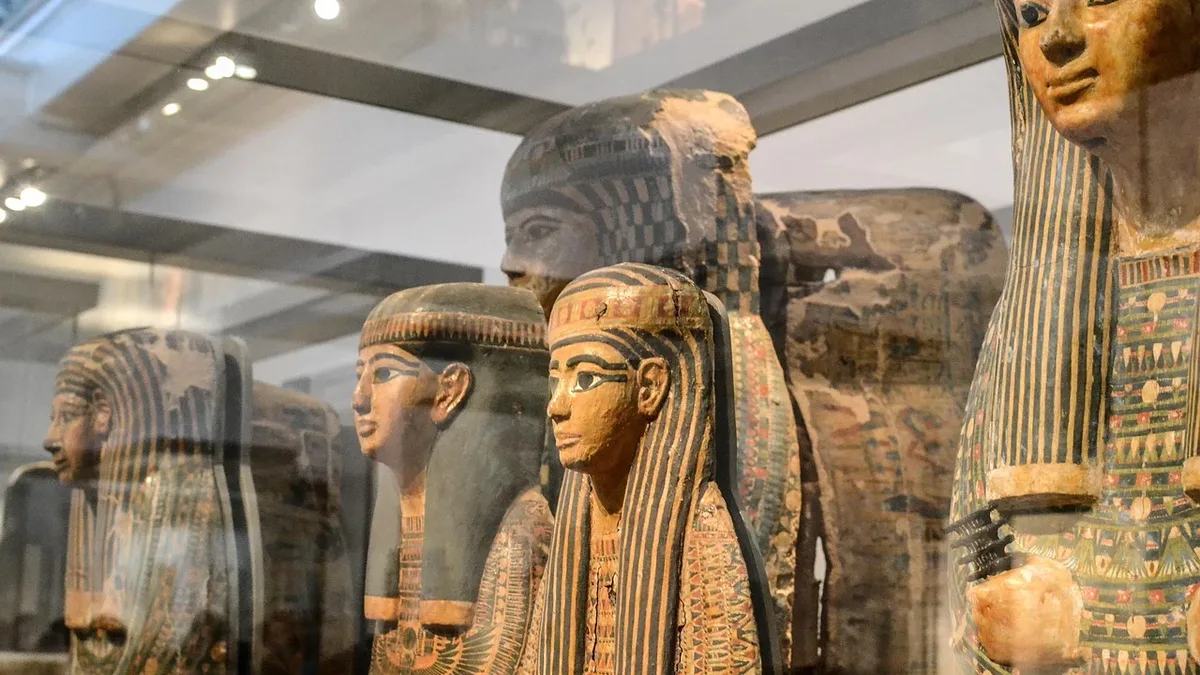
More than 100 shabti figurines were recovered. In ancient Egyptian belief, these statuettes were intended to serve the deceased in the afterlife. The team also discovered a wooden statue of a falcon, possibly connected to the god Horus, and remains of cartonnage-a plastered material used in mummification. The mummy of Sekhentio-Ptah himself was not identified.
Evidence of Later Reuse
Examining released photos and information, Roth suggested the tomb was likely reused for later burials, a common practice in ancient Egypt. She indicated that the numerous shabtis and the cartonnage fragments probably belong to these later interments, not to the original burial of Sekhentio-Ptah.
The tomb was located in the Bubasteion area of Saqqara. This site is widely known for its cat burials from much later periods, such as the Late Period (circa 664 to 332 B.C.), and its association with the feline goddess Bastet. The ministry's statement did not report finding any cat burials within this specific tomb.
The Site and Its Significance
The discovery was made at Saqqara, the vast necropolis that served the ancient Egyptian capital of Memphis. The Old Kingdom period, spanning from roughly 2649 to 2150 B.C., is renowned for pyramid construction, including the famous monuments at Giza. The find sheds light on the burial practices and administrative roles of elites from this key era.
The excavation team discovered the tomb in the Bubasteion, an area later dedicated to the cat goddess Bastet. While the tomb's original occupant was a senior official from the pyramid age, the artifacts suggest his final resting place saw use for centuries after his death.