Ancient English Volcano Revealed by Zircon Dating
Geologists have identified a 454.4-million-year-old volcano beneath eastern England, linked to a vast ash deposit in Scandinavia.
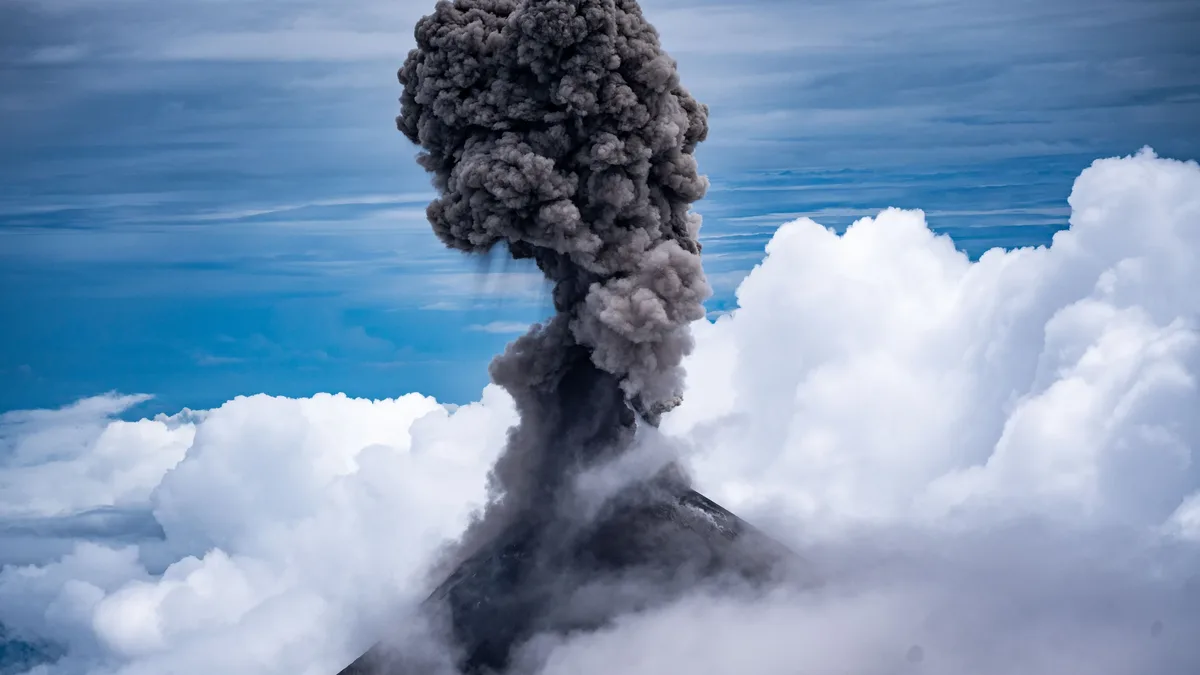
Geologists have pieced together the existence of a massive 454.4-million-year-old volcano hidden beneath the counties of Norfolk and Lincolnshire in eastern England. The discovery, detailed in a study published in the Geological Society of America Bulletin, connects the ancient volcano to a thick layer of ash found in Scandinavia.
Researchers analyzed tiny zircon crystals retrieved from boreholes 40 miles apart. These crystals, which form in magma before an eruption, contain uranium that decays into lead at a known rate, allowing for precise dating. The analysis showed the crystals from England matched the age of zircon found in the Kinnekulle tephra, a significant volcanic ash layer covering Scandinavia and the Baltic region.
Linking Eruption to Ash Fall
This age match indicates that ash from the English volcano traveled across the Tornquist Sea, an ancient body of water, and settled in what is now Scandinavia. While scientists already knew the Kinnekulle tephra came from a major eruption, the new work reveals the astonishing distance the ash traveled, highlighting the eruption's scale. The study also found evidence for a slightly later eruption from the same volcano around 453.7 million years ago.
Peter Rowley, a volcanologist at the University of Bristol not involved in the study, told Live Science the eruption would have produced enormous pyroclastic flows. He compared its scale to the Oranui eruption at New Zealand's Taupō volcano over 26,000 years ago.
The 'Supervolcano' Debate
Despite the eruption's clear magnitude, experts quoted by Live Science are hesitant to label the structure a 'supervolcano'. Michael Poland, a research geophysicist with the Yellowstone Volcano Observatory, noted the poor preservation of volcanic deposits makes calculating the eruption volume very difficult. "This is part of the reason I really hate the term 'supervolcano,'" Poland said.
Stephen Self, a volcanologist at UC Berkeley, called 'supervolcano' a buzzword. Volcanologists prefer more precise terms based on the volume of ejected material. For this event, Rowley said the appropriate description is an "ultraplinian" eruption, the most violent class, which ejects more than 240 cubic miles of material.
A Fragmentary Geological Record
The volcano's remains are deeply eroded and buried under some of England's flattest landscapes, with no surface traces of the eruptions visible today. Tim Pharaoh, the study's lead author and a geophysicist with the British Geological Survey, noted this in a statement. Rowley explained that the geological record is incomplete, making it hard to quantify exact eruption volumes from such ancient events.
What researchers find are not whole volcanoes but deformed deposits from eruptions or rocks from underlying magma chambers. The newly identified volcano is part of a broader volcanic system active 450 million years ago, which also includes areas in Wales and northwestern England. The careful analysis of zircon crystals was important to interpreting this hidden geological picture.