Roman skeleton found hiding in jar at Deultum gate
Archaeologists in Bulgaria discovered a 1,600-year-old skeleton inside a large storage jar within a Roman gate tower.
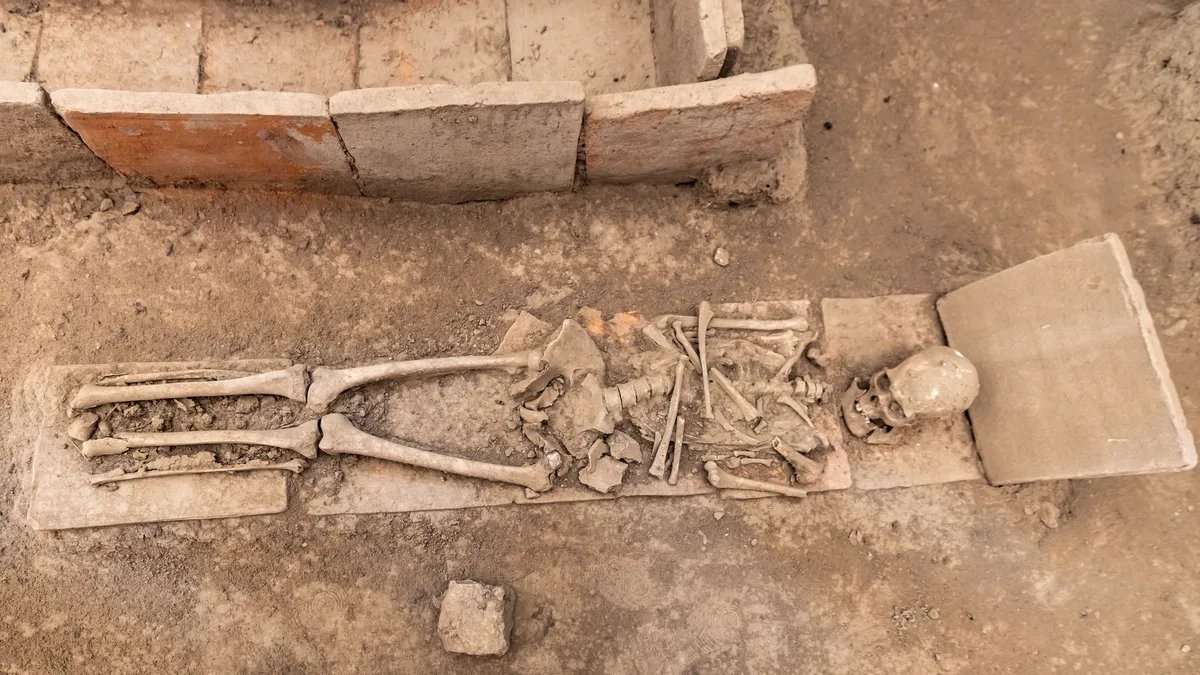
Archaeologists in Bulgaria have unearthed a human skeleton inside a giant Roman storage jar, or dolium. The discovery was made on August 10 in the northern turret of the western gate of the Roman colony of Deultum.
Lead excavator Lyudmil Vagalinski, an archaeologist at the Bulgarian Academy of Sciences, told Live Science the team was surprised by the find. Human remains are rarely found inside ancient cities except under extraordinary circumstances like enemy attacks or natural disasters. The individual, presumed to be a young man, was found with two iron knives and a belt.
The Site and the Jar
The dolium was found in a Late Roman turret, a small defensive tower. These large ceramic vessels were the biggest type of pottery in antiquity, used for storing goods like olive oil and wine. While the largest could hold over 260 gallons, the surviving lower portion of this one measures about 3 feet in diameter.
The team's preliminary analysis dates the event to around A.D. 400. Deultum faced numerous attacks from East Germanic tribes and Huns during the fourth and fifth centuries, though the specific battle involved is unknown.
Evidence of Catastrophe
Signs of a violent event surrounded the jar. Archaeologists found a significant amount of burned material, including ashes, coals, broken bricks and tiles, and blackened walls. They also discovered melted glass fragments and bones from domestic animals.
Vagalinski suggested people likely brought livestock into the fortress ahead of an imminent attack. Many bronze coins, probably lost in the chaos, were also found. The presence of ashes under the skeleton indicates the individual climbed into the dolium after a fire had already begun.
A Fatal Hiding Place
The young man appears to have hidden in the empty jar. He held one iron knife between his legs, with a second knife in his belt. "In any case, he made no attempt to get out of the ceramic vessel," Vagalinski said. The team determined this from the individual's position, which resembled that of a sleeping person.
After the attack, inhabitants leveled the tower's ruins and covered them with a new, higher floor. They were unaware a fellow citizen lay at the bottom of the jar.
Future Work
The skeletal remains have been moved to Sofia for analysis by a physical anthropologist. Next summer, the team plans to return to Deultum to excavate the entire western Late Roman gate, which dates to around A.D. 300. They aim to reveal its full plan and establish a proper chronology.
They also intend to complete the investigation of the northern turret where the dolium was found. Earlier this year, the team discovered an older latrina, or toilet, dating to between the second and third centuries near the same gate.