Skeleton 150: First Trebuchet Death Evidence
A 14th-century skeleton found in Stirling Castle, Scotland, shows 167 fractures that may mark the earliest proven death by a trebuchet, possibly the War Wolf ordered by Edward I.
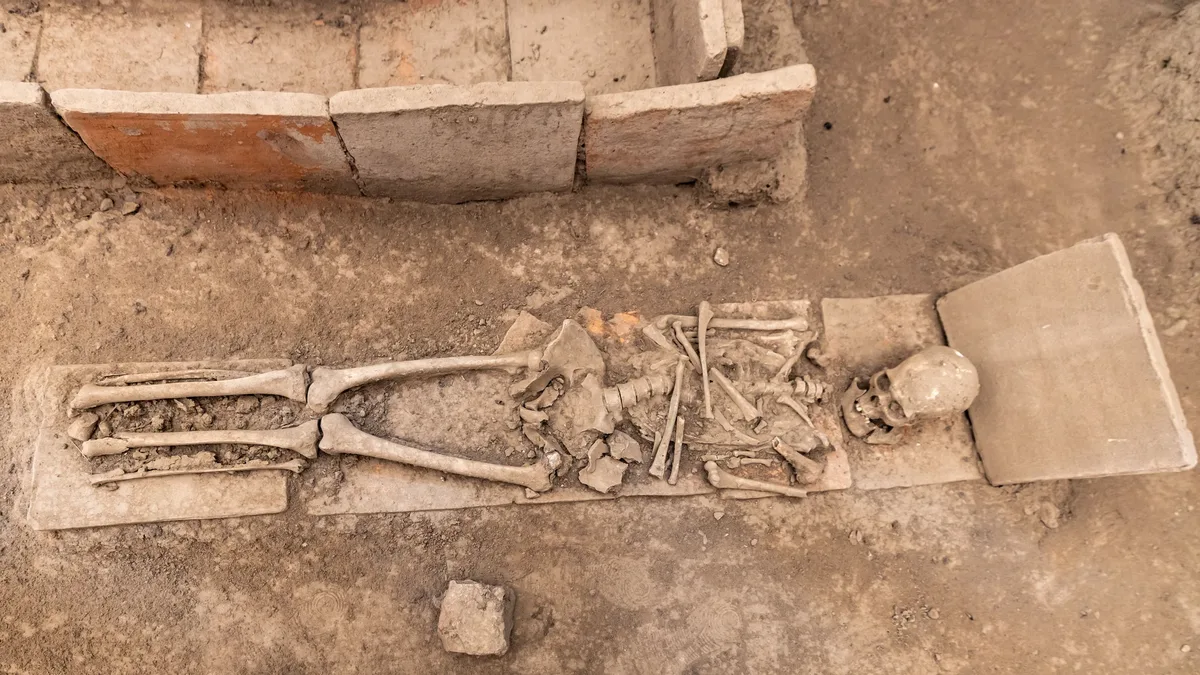
A medieval man buried beneath Stirling Castle’s chapel, now called Skeleton 150, bears 167 fractures that researchers say could be the oldest recorded death caused by a siege engine.
Discovery and Context
The remains were uncovered in 1997 during a dig beneath the royal chapel of Stirling Castle, a fortress that played a key role in the Wars of Scottish Independence. Eight skeletons were found together, a rarity because most medieval burials occurred in parish churches. The site was presented at the 25th European Paleopathology Association meeting in Berlin on August 5, 2026, by Jo Buckberry, a biological anthropologist at Bradford University.
Buckberry noted that all eight skeletons displayed trauma from blunt objects, projectiles, or sharp blades, but Skeleton 150 stood out with an unusually high number of fractures. The skeleton was dated to about 1300 through carbon-14 analysis, placing it in the middle of the First War of Independence and near the time Edward I was experimenting with siege engines.
Fracture Analysis
Using micro-CT and 3D scanning, Buckberry and colleagues documented 61 skull fractures, 57 rib fractures, and breaks in the vertebrae, arms, and right shoulder. The damage concentrated on the upper half of the body and followed a zig-zag pattern uncommon in archaeological finds. “I started looking at the forensic literature and the forensic collections,” Buckberry said, comparing the pattern to a zig-zag rib fracture seen in modern road-traffic accidents. “That’s great, but I’m in medieval Scotland, and a traffic accident is not likely to be the case.”
The pattern suggests a high-velocity impact while the individual was standing. Buckberry described the death as instantaneous, with the victim “going from standing to the floor extremely rapidly.” The analysis also ruled out post-mortem trampling, confirming the fractures occurred around the time of death.
Possible Siege Weapon
Historical records show that Edward I’s 1304 siege of Stirling Castle employed up to a dozen siege engines, including the War Wolf, the largest trebuchet of its time. The War Wolf reportedly launched a missile that pierced two walls of the castle. Buckberry cautioned that it is difficult to prove the War Wolf caused the death, but she considered a similar siege engine the most likely source of the injuries.
The discovery of Skeleton 150 adds a new /fixture to the list of medieval battlefield casualties, and the detailed /stats of the fractures provide a rare glimpse into the lethal power of early siege technology. The skeleton, a young man in his 20s, was named Skeleton 150.
Buckberry, J. (2026, August 5). Skeleton 150 from Stirling Castle, Scotland: The first evidence of trebuchet trauma in the archaeological record. 25th European Paleopathology Association Conference, Berlin, Germany. Https://cfp.dainst.org/25th-european-ppa-meeting/talk/GHF9V8/