Mars Volcanoes Emit Hydrogen Chloride Gas, Orbiter and Lander Data Show
A study published November 4, 2024, provides the strongest evidence yet that hydrogen chloride gas is seeping from vents near Mars's Alba Mons volcano, detected seasonally by the ExoMars Trace Gas Orbiter and linked to crustal activity by NASA's InSight lander.
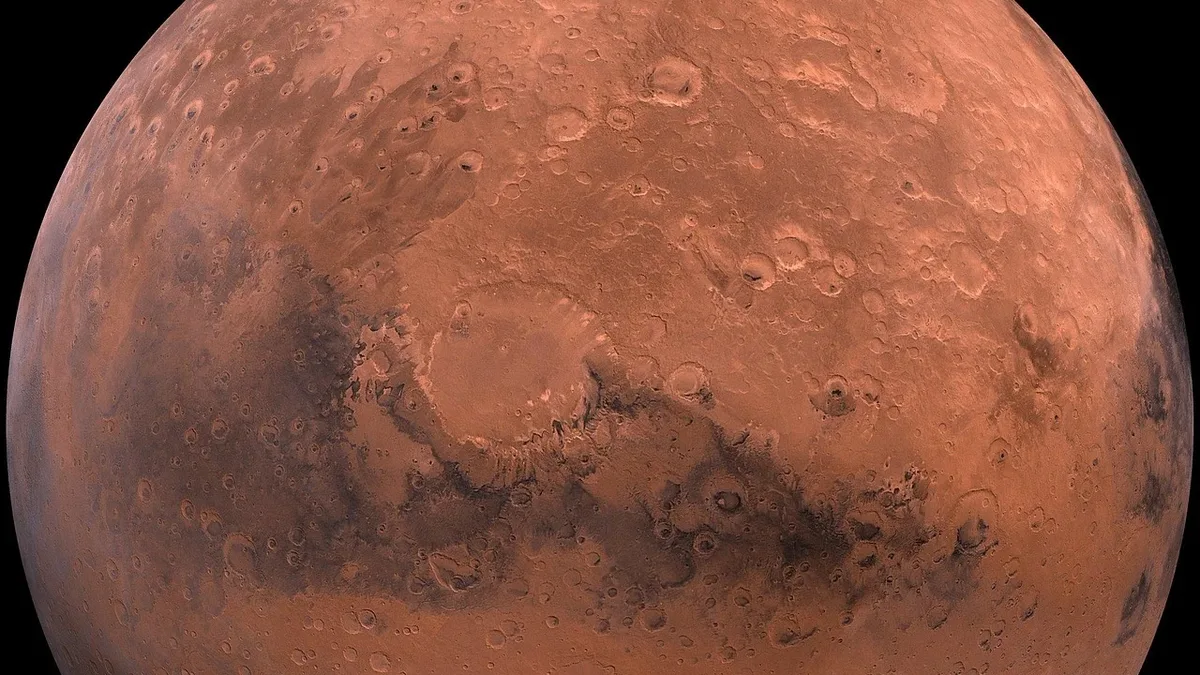
The strongest evidence yet shows hydrogen chloride gas being released from dormant Martian volcanoes, detected seasonally by orbiters and landers. Alexander Trokhimovskiy of Russia's Space Research Institute called the new findings the strongest evidence yet of gases released by dormant Martian volcanoes. The study, published in Science Advances on November 4, suggests the gas detected by the ExoMars Trace Gas Orbiter may originate from magma beneath the surface near Alba Mons, the largest volcano on the planet by surface area. These findings suggest Mars may not be as geologically dormant as previously thought. Researchers suggest the gas may indicate an environment similar to Earth's hydrothermal vents where life likely began.
Multi-instrument confirmation
The research combines data from the ExoMars Trace Gas Orbiter, which made atmospheric observations, and NASA's InSight lander, which monitored crustal activity. Daniel Mège, a planetary geologist at the Polish Academy of Sciences, identified fissures where gas may escape and said the two data sets strengthen each other. InSight spotted crustal activity while the orbiter detected atmospheric emissions. A targeted measurement campaign lasted two Mars years, approximately four Earth years, confirming a distinct and pronounced signal that later faded below the detection threshold. The gas appeared locally and nowhere else across four Mars years of observations. NASA's InSight lander had earlier interpreted magma presence from seismic observations and modeling.
Localized and seasonal emissions
The gas signal was found to be localized and inconsistent with regular atmospheric chemistry. HCl was detected above the Alba Mons region, where fresh surface fissures have been identified. The detections occurred during the Martian cold aphelion season, corresponding to spring and summer in the Northern Hemisphere. The gas also appeared in the northern hemisphere's winter, not just the southern spring and summer, with measurements close together in place and time across two consecutive Mars years. The Space Research Institute of the Russian Academy of Sciences identified traces of hydrogen chloride at parts-per-billion concentrations using the Atmospheric Chemistry Suite aboard the ExoMars Trace Gas Orbiter.
Implications for habitability
The gas is not a direct sign of life but suggests environments similar to Earth's hydrothermal vents where life may have originated. Earth's first life-forms came from hydrothermal zones, which combine materials and energy similarly to possible Martian vents. Conditions in the area would need to remain favorable for millions of years for life to form, though magma activity alone is not a sign of life. The study shows no evidence of life on Mars; the gas release signal requires confirmation and suggests locations for future observations. Scientists were initially cautious about linking the gas to volcanoes, noting it followed seasons, was not concentrated over likely volcanic regions, and other volcanic gases like sulfur were absent.
The study suggests the gas may be released in 'puffs' rather than continuously. Researchers suggest continued ExoMars Trace Gas Orbiter observations over the Tharsis and Cerberus regions could reveal more HCl emissions.