Roman-era man from southern Britain reconstructed after decapitation burial near Inveresk
A man buried near a Roman fort in Scotland, who died between A.D. 142 and 165 after being decapitated, was virtually reconstructed by researchers.
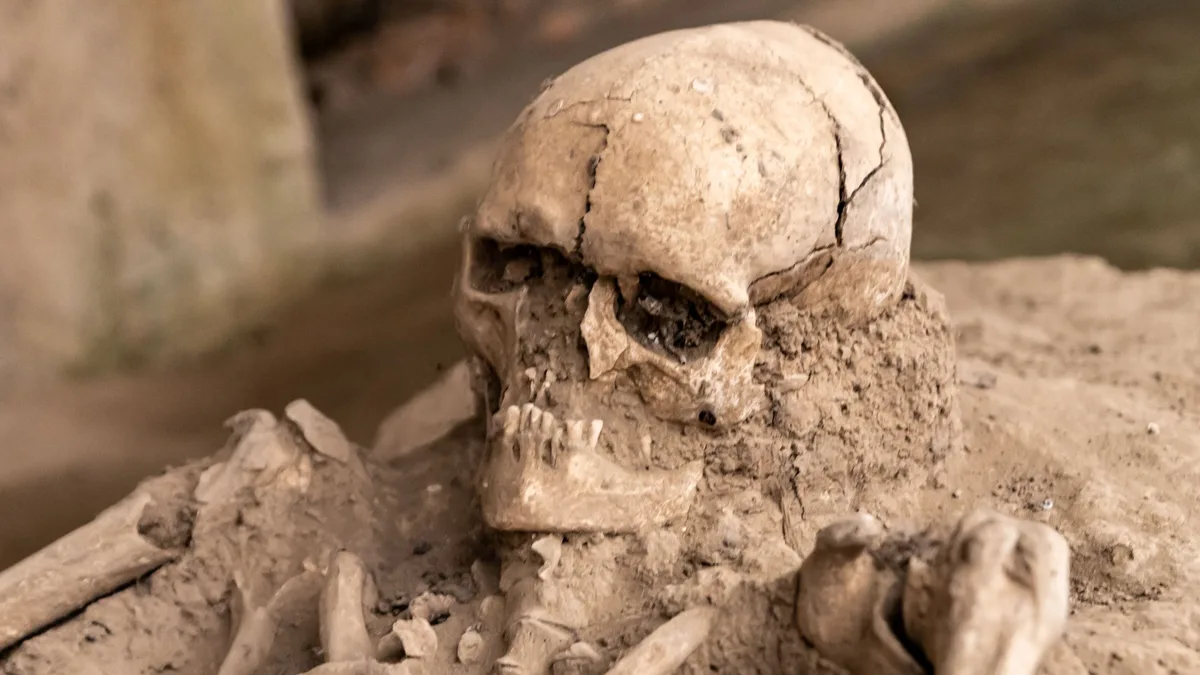
A man from southern Britain was buried near the Roman fort at Inveresk with evidence of decapitation after death and limited arm mobility. He was about 50 years old when he died between A.D. 142 and 165, one of six men buried at the site with four similarly beheaded.
His skeleton showed a broken and healed nose and extensive bone growth in his right elbow, possibly from arthritis or septic arthritis. This injury severely limited the arm's movement, meaning he could not have wielded a sword. Scientists believe he may have worked for the Roman army in a non-combat capacity. John H. Reid suggested, "He could have been left-handed, or he could have had a 'desk job'." Isotopic analysis indicates he grew up in southern Britain, having traveled hundreds of miles north to Inveresk, just southeast of modern Edinburgh.
Context of the Inveresk fort
The Roman fort at Inveresk was built around A.D. 140. It acted as a command-and-supply center for Roman forts along the Antonine Wall. This construction was part of a second Roman push to secure southern Scotland after an earlier retreat to Hadrian's Wall. The effort ultimately failed after A.D. 162.
Burial practices and regional patterns
Four of the six Roman-era burials found at Inveresk involved post-death decapitation. The man was buried with dignity, unlike executed criminals. Archaeologist John G. Reid proposed the decapitation may have been an obscure burial rite among some southern Britain populations, as other headless burials from the same period exist in southern Britain. This practice at Inveresk is believed to be the first identified in Scotland and among the earliest in the U.K.
Scientific reconstruction
Researchers at National Museums Scotland and forensic anthropologist Christopher Rynn created the facial reconstruction. Dr. Chris Rynn, a forensic artist, built the likeness using an osteoarchaeological assessment, analysis by Durham University, and ancient DNA research by the University of York, Harvard Medical School, and National Museums Scotland. Dr. Jess Thompson, curator of osteoarchaeology at National Museums Scotland, stated that the facial reconstruction connects new science with artistic vision to create a dynamic portrait of the man.
An examination showed he led an active life despite his injuries. The reconstruction gives a tangible sense of an inhabitant of Roman Scotland, though the exact appearance cannot be known. The facial reconstruction will be displayed in National Museums Scotland's 'Roman Scotland: Life on the Edge of Empire' exhibit.